DEBBIE HARRY SINGS IN FRENCH by Megan Brothers (2008)

Henry Holt and Company; 234 pages; realistic fiction; ages 13 and up; ISBN: 978-0-8050-8080-3.

This coming-of-age novel centers on Johnny, a 1990s Florida teen whose dad dies in a car crash the week of his 13th birthday. His mom, too depressed to do much of anything over the next couple years, leaves chores like shopping for groceries and paying the bills to Johnny; he starts drinking to deal with the pressure. After she recovers and takes charge of the household again, Johnny accidentally overdoses on Ecstasy one night at a club. He goes into rehab, but following his own recovery, his mom sends him to South Carolina to live with his uncle Sam, whereupon he meets and falls for Maria, a “bad girl” who shares his love of 1970s punk rock (Blondie, Patti Smith, the Ramones) and helps Johnny explore his latent interest in transvestism.

Debbie Harry Sings in French received a starred review from Publishers Weekly for its “brisk pace and ... strong-willed, empathetic narrator,” although, like Kirkus Reviews, it took issue with Brothers’s plot, which the latter found “problematic,” especially in the early chapters set in Tampa. I’m sure a movie adaptation would cut the bulk of those chapters, but I enjoyed how Brothers presented a single-parent household in which the only child, out of sheer necessity, takes on the responsibilities of the incapacitated parent. Booklist’s Jennifer Hubert noted that “the prose occasionally slides into cliché,” but I’d argue it’s the supporting characters who sometimes run the risk of being stereotypes: Lucas, the hip, wise Jamaican record store owner, skirts the edge of “Magical Negro” status, and Bug, Johnny’s female cousin, acts more like a precocious second grader than an 11-year-old on the cusp of adolescence.

For further reading, check out Parrotfish by Ellen Wittlinger (2007).

THE SKIN I'M IN by Sharon G. Flake (1998)

Jump at the Sun/Hyperion; 171 pages; realistic fiction; ages 11 and up; ISBN: 978-142310385-1.

Seventh grader Maleeka Madison is picked on because of the darkness of her skin. When a new language-arts teacher named Miss Saunders arrives at her inner-city middle school as part of a corporate program that puts advertising executives in classrooms for a year, Maleeka finds herself in the presence of a caring mentor, though she doesn't know it at first. In fact she resists Miss Saunders's attention and concern almost every step of the way, partly because the new teacher has a large white birthmark on her black face, making her, in Maleeka's mind, as much of a target for negative comments as Maleeka herself. The protagonist must also deal with an aggressive classmate named Charlese, who lets Maleeka wear her fashionable clothes in exchange for doing Charlese's homework every night.

Author Sharon G. Flake makes the point of providing hints as to how a "bad girl" like Charlese came to be: we see that her home life consists of no parents and an older sister who throws parties that last entire weekends. We also learn why John-John, one of Maleeka's worst verbal tormentors, began disliking her in the first place. The Skin I'm In wraps up its various plot threads a little too neatly (did Maleeka really have to find romance with the cutest boy in school?), but Flake energizes her story as a whole by telling it in Maleeka's urban-teen vernacular ("I ain't no squealer. Never was, never will be."), and her account of a near-rape that Maleeka narrowly escapes is told with vivid, heart-rending suspense.

Winner of the Coretta Scott King Book Awards' John Steptoe New Talent Award in 1999. For further reading, check out The First Part Last by Angela Johnson.

COOLIES by Yin (2001)

Illustrated by Chris Soentpiet. Philomel/Penguin Putnam Books for Young Readers; 40 pages; history; ages 7-10; ISBN: 0-399-23227-3.

Shek and his younger brother, Wong, leave famine-devastated China for America in the mid-1800s to find work building the First Continental Railroad along the western portion of the country. Their goal is to send money home so their remaining family members won't starve. On top of back-breaking work and discrimination from white railroad foremen, who condescendingly call the Chinese "coolies," or slaves, Shek, Wong, and their fellow immigrants discover they're being paid less than non-Chinese laborers. They go on strike, but Shek reminds them that as long as they don't work, they can't send money back to their families in China.

Yin tells her story with a framing device involving a tween boy and his grandmother, who regales him with the history of her great-grandfather and his brother—Shek and Wong, respectively. Soentpiet's drawings employ wide-screen, sun-kissed vistas that add cinematic flair to Yin's heartfelt, human prose. "Call us what you will," Shek says upon the completion of the First Transcontinental, "it is our hands that helped build the railroad."

For further reading, check out Ten Mile Day and the Building of the Transcontinental Railroad, written and illustrated by Mary Ann Fraser (1993).

CROOKLYN (Universal Pictures, 1994)

Directed by Spike Lee; screenplay by Cinqué Lee, Joie Susannah Lee, and Spike Lee; 115 minutes; comedy/drama; MPAA rating: PG-13 ("for drug content," which means two characters who sniff glue, but appropriate for ages 10 and up, if you ask me).

Troy Carmichael lives in Brooklyn with her four brothers, her schoolteacher mom, and her jazz-musician dad, who's been having trouble finding work lately. This causes tension at home, but most of it is kept out of sight of the kids, who spend their summer playing outdoors till the sun goes down, watching The Partridge Family when they're not supposed to have the TV on, and getting into mischief that occasionally involves their odd neighbor "Tony Eyes," a nearsighted man with oversized eyeglasses who owns several small dogs that are constantly barking. Troy reluctantly takes a trip down south to stay with her aunt Song and uncle Clem for a week, but she ends up having more fun than she expected with her cousin Viola. When she returns home, however, she finds that everything is suddenly about to change for good in the Carmichael household.

Set in the early 1970s, Crooklyn is episodic in nature and therefore won't appeal to everyone, but because it's semi-autobiographical—oldest brother Clinton appears to be based on cowriter-director Spike Lee, and Troy seems to represent cowriter Joie Susannah Lee (both have cameos in the film)—the Carmichael house feels like it's actually been lived in, not constructed for use in a movie. The Carmichael kids are almost always yelling and fighting with each other about something, but unlike the kids on Hannah Montana, for instance, their fights aren't constructed around well-rehearsed one-liners. And when the Carmichaels talk back to their mom, they suffer the consequences right away.

The last 20 minutes of Crooklyn may be too intense for younger viewers in the same way that Doris Buchanan Smith's book A Taste of Blackberries was too intense for me when I was eight years old. But it's a hell of an ending, one that makes me cry every time I watch the film. (Another selling point is Crooklyn's wall-to-wall soundtrack of early-'70s R&B hits, including the Spinners' "Mighty Love," Jean Knight's "Mr. Big Stuff," and Stevie Wonder's "Signed Sealed Delivered I'm Yours.")

For further viewing, check out Akeelah and the Bee (2006). And to see a trailer for Crooklyn, click here.

A WREATH FOR EMMETT TILL by Marilyn Nelson (2005)

Illustrated by Philippe Lardy. Houghton Mifflin; 48 pages; history; ages 12 and up; ISBN: 0-618-39752-3.

As Marilyn Nelson explains in the foreword to her book-length poem, A Wreath for Emmett Till is a heroic crown of sonnets, "a sequence of fifteen interlinked sonnets, in which the last one is made up of the first lines of the preceding fourteen." Till, a 14-year-old Chicago boy, was visiting relatives in Mississippi in the summer of 1955 when he was kidnapped and murdered by two white men for supposedly whistling at a white woman. Till's mother held an open-casket funeral so the public could see how her child was mutilated by these men, who were charged with the murder but ultimately acquitted after a trial by all-white jury. Nevertheless, the battle for civil rights in the Deep South had begun.

Nelson's words pack a punch, particularly in this segment of one particular sonnet:

This country we love has a Janus face:
One mouth speaks with forked tongue, the other reads
the Constitution. My country, 'tis of both
thy nightmare history and thy grand dream,
thy centuries of good and evil deeds,
I sing ...

Tweens who stick with A Wreath for Emmett Till through Nelson's various twists and turns of phrase will be rewarded with an experience that bears comparison to a fiery gospel sermon delivered by a preacher whose heart is filled with equal parts rage and forgiveness. (Lardy's artwork is pretty, but the pen is mightier than the brush here.) Not easily forgotten.

For further reading, check out Chris Crowe's Getting Away With Murder: The True Story of the Emmett Till Case (2003).

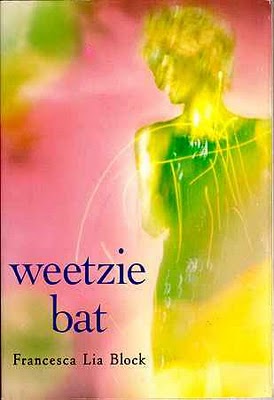
WEETZIE BAT by Francesca Lia Block (1989)

HarperCollins; 109 pages; magical realism; ages 12 and up; ISBN: 978-0-06-073625-5.

Weetzie grew up in Los Angeles and is nostalgic for a Hollywood she never knew, yet it's one we all unconsciously know, the golden age of stars like Bogart and Monroe. Weetzie is in her early 20s and a little lost when she meets Dirk, who becomes her new best friend. Dirk's gay, and Weetzie helps him in his search for an ideal boyfriend. Together they find Duck, while Weetzie falls for the one and only Secret Agent Lover Man. The two couples then move in together, but author Francesca Lia Block doesn't provide them with "happily ever after" until she's thrown a wrench or two into the works, plus a baby, a disease, and a death or two.

If you're in the right frame of mind, Weetzie Bat is a fun read that operates mostly on dream logic as it blends elements of 1980s L.A. with 1950s La-La Land. Tweens and teens discovering the book today can learn a little about the AIDS epidemic that permanently changed the American landscape in the '80s for both homosexuals and heterosexuals, though Block's then-progressive scenario of a woman and her two gay male friends raising a baby together may seem quaint to today's younger audiences. Thank God for that ...

For further reading, check out subsequent entries in Block's "Dangerous Angels" series: Witch Baby, Cherokee Bat and the Goat Guys, Missing Angel Juan, and Baby Be-Bop.

THE ABSOLUTELY TRUE DIARY OF A PART-TIME INDIAN by Sherman Alexie (2007)

Illustrated by Ellen Forney. Little, Brown and Company; 230 pages; realistic fiction; ages 12 and up; ISBN: 978-0-316-01369-7.

Arnold Spirit Jr. is an awkward but creative 14-year-old Spokane Indian who lives on a reservation with his parents and grandmother. On the first day of ninth grade at the "rez" school, he discovers his mother's maiden name in his "new" geometry textbook. Infuriated, he throws the book at his teacher, breaking the man's nose, but when the teacher comes to Arnold's house to talk to him about the incident, he encourages Arnold to do whatever he can to get off the reservation, before it kills his spirit. Arnold decides to enroll at the all-white high school in nearby Reardan, angering many Indians, especially his newly former best friend, Rowdy, who feels abandoned but can only express himself with his fists. But over the course of the school year, as he experiences one family tragedy after another amidst personal triumphs on the school's basketball court, Arnold comes to terms with his status as a part-time Indian.

Sherman Alexie's semiautobiographical novel is bursting with brash humor and unexpected tragedy (apparently seven of his relatives died in a single school year when he was around Arnold's age). It also doesn't pull any punches in discussing extreme poverty among Indians or the rampant alcoholism that's a direct cause—and effect—of that poverty. Ellen Forney's line drawings enhance Alexie's prose, so much so that it's hard to imagine the book without them. The Absolutely True Diary of a Part-Time Indian lives up to the critical hype.

Winner of the 2007 National Book Award for Young People's Literature. For further reading, check out The Skin I'm In by Sharon G. Flake or American Born Chinese by Gene Luen Yang. And to see a Glogster-hosted advertising poster I created for Part-Time Indian, click here.

DOCTOR PROCTOR'S FART POWDER by Jo Nesbø (2010)

Illustrated by Mike Lowery. Aladdin/Simon & Schuster; 265 pages; comedy; ages 9-13; ISBN: 978-1-4169-7972-2.

"The most successful Norwegian author of all time," according to this title's book jacket, turns his attention away from crime fiction and toward more juvenile matters, but if you're a reluctant reader of the male persuasion, you'll probably get a kick out of this goofy tale of a Norwegian boy named Nilly. When his family moves to a new house he makes the acquaintance of the girl next door, Lisa, and Doctor Proctor, a kindly inventor, whose latest creation is fart powder. There's a normal version that provides the funny noises without the terrible smells, but the doctor also has an industrial-strength version that can send Nilly up, up, and away into outer space (in a chapter entitled "The Fartonaut"). He hopes to sell the latter version to NASA, but another neighbor, the evil Mr. Trane, plans to steal the powder and sell it to the space agency first.

Despite the famous four-letter word in the title, Doctor Proctor's Fart Powder doesn't dwell on bathroom humor. Instead Nesbø uses the beloved/reviled bodily function to entice readers (again, those of the male persuasion) who might not otherwise want to read a story involving kooky inventors, stoopid twin bullies, and a giant snake that lives in the sewer. Nesbø's bone-dry style respects a general rule of comedy: no matter how outlandish your story becomes, always take it completely seriously.

For further reading, check out Nesbø's sequel, Doctor Proctor's Fart Powder: Bubble in the Bathtub (2011). (In case you haven't guessed already, kids, it includes farting too.)

CHARLOTTE'S WEB by E.B. White (1952)

Illustrated by Garth Williams. HarperCollins; 192 pages; fable; ages 8 and up; ISBN: 978-0-0644-0055-8.

Eight-year-old Fern lives on a farm. One day she prevents her father from killing the runt of a new litter of pigs. She names the pig Wilbur, who becomes friends with a wise, matronly spider named Charlotte in the farmer's barn. Wilbur becomes frightened and angry when he learns the culinary fate of all pigs ("I want to stay alive, right here in my comfortable manure pile with all my friends," he cries), so Charlotte spins a web—literally—that says "SOME PIG," which attracts attention from all over and earns Wilbur the new nickname of "Zuckerman's Famous Pig." Charlotte has saved Wilbur from the slaughterhouse, but how will he survive if she's no longer around to help him?

E.B. White's animal tale is an all-time classic, and for good reason: we all want mother figures like Fern and Charlotte to save us and make us feel secure in times of great need. Charlotte's Web also contains a great deal of gentle humor, most of it courtesy of Templeton, a rat who looks out for himself above all others but ultimately does the right thing when needed. After all these years, I still find it hard not to tear up during the final chapter.

Winner of a 1953 Newbery Honor Book award. For a more intellectual animal story, check out George Orwell's Animal Farm (1954).

MARCH OF THE PENGUINS (National Geographic Feature Films/Warner Independent Pictures, 2005)

Directed by Luc Jacquet; written by Luc Jacquet, Michel Fessler, and Jordan Roberts; 80 minutes; documentary; MPAA rating: G (all ages).

This fascinating documentary about emperor penguins in Antarctica, narrated by Morgan Freeman, tells of how they travel 70 miles, by foot or by belly, each year from the ocean to breed in a special area that's protected somewhat from harsh winds by high ice walls and has ice thick enough beneath the penguins' feet that it never melts or cracks all year round. After the penguins mate and the female gives birth, the male takes responsibility for keeping the egg safe and warm while the female travels 70 miles back to the ocean to feed herself—she hasn't eaten in two months by this point—and gather enough food in her stomach so she can feed her baby when she returns.

Spellbinding cinematography drives home the sensation that March of the Penguins is showing the viewer something truly unique. Antarctica looks breathtaking, as in "Its natural beauty will take your breath away" and "It's so cold you'll stop breathing." Some tween viewers may be wary of watching documentaries on nature at this stage in their lives, but they'll warm up (no pun intended) to this one once they see the penguins on their march, waddling back and forth. Plus, baby penguins are mighty cute.

For further viewing, check out Happy Feet (2006), an animated song-and-dance story about penguins.